Signs That Your Routine Service Scheduling Needs an IoT Monitoring System
Updated: Mar 20

Growth is supposed to feel like progress. But for many remote OEM service teams, growth feels more like scheduled chaos.
More customers means more routine visits.
More calls about equipment failures.
More "We should probably add another tech".
More trucks. More miles. More hours.
And it adds up fast.
A routine service schedule eats time, even when nothing is wrong. Phone support eats time, because you are troubleshooting blind. Hiring eats profits, and it is slow. Buying trucks eats money, and it never stops at one.
If you do not have an IoT monitoring system in place, you are wasting time and money.
Not because your team is doing a poor job, but because you are running a service without real-time visibility.
The Real Business Cost of Reactive vs Predictive Service
Most service organizations are built around reactive work.
You find out something is wrong when:
A customer calls
A tech shows up on a routine visit
A system fails, and downtime forces action
That means you are always late.
Late to the problem. Late to the fix. Late to the customer experience.
And when you are late, everything costs more.
Emergency trips. Rush parts. Overtime. Frustrated customers. Lost accounts.
IoT monitoring flips this and reduces costs.
It lets you scale with the right number of people by prioritizing service runs based on severity, not based on guesswork or a calendar.
What does IoT mean?
IoT means Internet of Things.
It refers to physical devices that are connected to the internet, allowing them to collect, send and receive data from equipment and environments.
What is IoT monitoring?
IoT monitoring is a connected remote equipment monitoring system that collects live data from customer equipment, sends it to a dashboard, and alerts your team when action is needed.
Instead of hoping everything is fine until your next visit, you have instant, real-time data on all systems at all times.
This is also known as industrial IoT (IIoT) monitoring.
Same idea. Same outcome.
Fewer surprises. Better service. Less wasted effort.
Examples of IoT collecting data
A tank with a level sensor sending data to the cloud.
A pump system reporting run status and faults remotely.
A fermentation vessel tracking temperature, pH and pressure in real time.
A machine alerting when consumables are low.
You don’t need to reinvent your equipment with new parts to get IoT connectivity. You can use your existing sensors to collect data, and transmit it to the cloud using an IoT device, to create visibility.
And visibility is what makes service efficient.
See how the 4 IoT data categories we use on all systems to turn raw machine data into better service decisions.
How does IoT monitoring work?
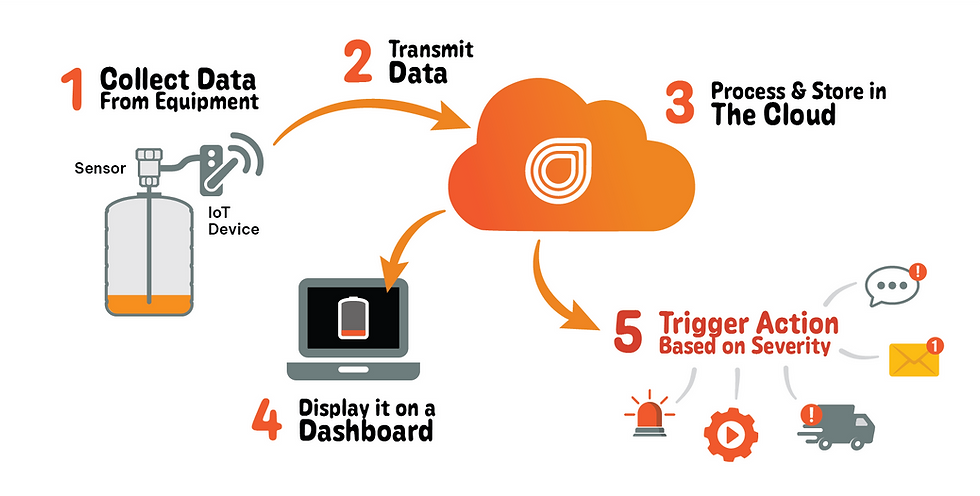
Most IoT monitoring systems follow the same structure.
1) Collect data from the equipment
Sensors and devices capture what matters: levels, temperature, runtime, vibration, faults, power usage, and system health.
2) Transmit data reliably
An IIoT controller or gateway gathers those signals and transmits the generated data via cellular, Ethernet, or WiFi.
3) Process and store in the cloud
A cloud platform stores history and uses cloud computing to organize data into meaningful insights.
4) Show it in a user-friendly IoT dashboard
A user-friendly IoT interface makes it easy to understand the status at a glance. Dashboards show trends, alerts show severity, and workflows help your team respond fast.
5) Trigger action based on severity
This is the real win. IoT monitoring allows you to prioritize service runs based on what matters most:
Critical issues first
Rising risk second
Routine checks no longer needed
That is how you reduce wasted trips and avoid learning about problems too late during routine service visits.
Book Your IoT Data Strategy Session and Start Generating Visibility
Most companies start by shopping for hardware and DIY it so they capture every single data point.
That is usually a mistake. Because the system is not just devices and dashboards.
It is a plan.
If you want IoT monitoring to actually reduce cost and improve service, you need to know:
What your current service workflow looks like
Which issues eat the most time and money
Which assets matter most
What data would help you catch problems earlier
What alerts should trigger action
What dashboards will actually get used
That is why we start with a 4-Step Data Strategy.
Book your IoT Data Strategy here:
Build the Remote Monitoring System That Fits Your Business
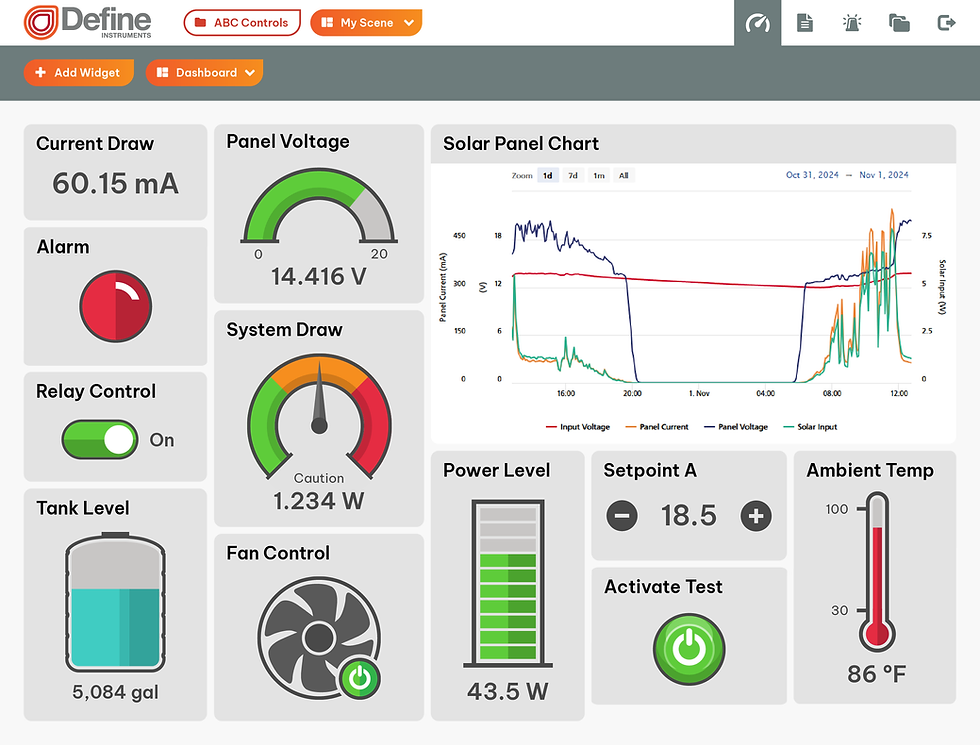
Once you know what you need, we can work together to build it.
You get a plan that matches how your service team operates.
And once it is live, you start running the service the right way:
Catching issues before your customers do.
Prioritizing dispatch based on severity.
Reducing routine trips that find nothing.
Scaling your reach without scaling chaos.
With an intuitive, user-friendly IoT dashboard interface, you will have instant coverage on all systems at all times.
That is what IoT monitoring is supposed to do.
It does not just show data.
It gives your business control.


